.png)
Most luxury founders we speak with already use AI every week. A copywriter drafts product descriptions in ChatGPT, a marketing lead asks Claude to summarise a campaign report, and the founder uses it to think through a launch plan. The tools are capable, yet the answers they give often read as if they were written for any brand at all.
That gap has a simple cause. Your AI tool has never seen your sales figures, your ad results or your search data. It has not read your brand guidelines, and it has no idea what you are launching next season. Each time someone opens a new chat, they start from zero and paste in whatever context they can find.
A new standard called MCP is starting to close that gap. This post explains what it is in plain terms and why it matters for brands that sell on craft, detail and voice.
The problem: your AI does not know your business
Think about the last time someone on your team asked an AI tool a real business question. Perhaps it was “Why did online sales dip in March?” or “Write three Instagram captions for the new leather collection.”
For the first question, the AI can only guess, because it cannot see your Shopify data, your Google Ads account or your Search Console report. Someone has to export spreadsheets, clean them up and paste them in. By the time that is done, the moment to act has often passed. Retail intelligence company EDITED calls this the “copy-paste loop” and describes it as time-consuming and error-prone.
For the second question, the AI will write something, and it will usually sound polished. It will also sound like every other brand. It might call a hand-stitched bag “elevated” or “timeless,” use exclamation marks your brand would never use, or quote a price that is wrong. Your team then spends more time correcting the copy than it would have taken to write it from scratch.

Vogue heard the same concern from brand consultant Karmen Tsang:
Over-reliance on AI, she warns, risks producing work that is derivative rather than distinctive. “The content can become instantly forgettable, and adds little real value.”
Amy Francombe, “The Anti-AI Slop Playbook,” Vogue, 30 March 2026
Your data lives in one set of tools and your brand knowledge lives in PDFs, decks and people’s heads, while the AI sits somewhere else and knows about neither.
Camille Oudinot, Strategic Design Group Lead at Niji, puts the cause plainly:
AI doesn't make luxury brands generic. Brands do, by not telling AI what makes them different. Models default to the statistical middle of language.
Camille Oudinot on LinkedIn, 8 July 2026
What MCP is, in plain terms
MCP stands for Model Context Protocol. Anthropic, the company behind Claude, released it as an open standard in November 2024. Other major AI companies have since adopted it. OpenAI announced support in March 2025, and its developer documentation now explains how to connect MCP servers to ChatGPT. A few weeks later, Google said it would add MCP support to Gemini.
The easiest way to think about MCP is as a universal adapter. Before USB became common, many devices needed their own cable. MCP does something similar for AI tools: it gives them one standard way to connect to outside sources of information, such as a sales platform, an analytics account or a document library. The official MCP documentation uses the same comparison and calls MCP “a USB-C port for AI applications.”
Once a source is connected through MCP, your AI tool can look things up when it needs to. You ask a question in plain language, the AI fetches the relevant numbers or documents, and it answers using your real information. Nobody has to export a spreadsheet or paste a brand guide into the chat.
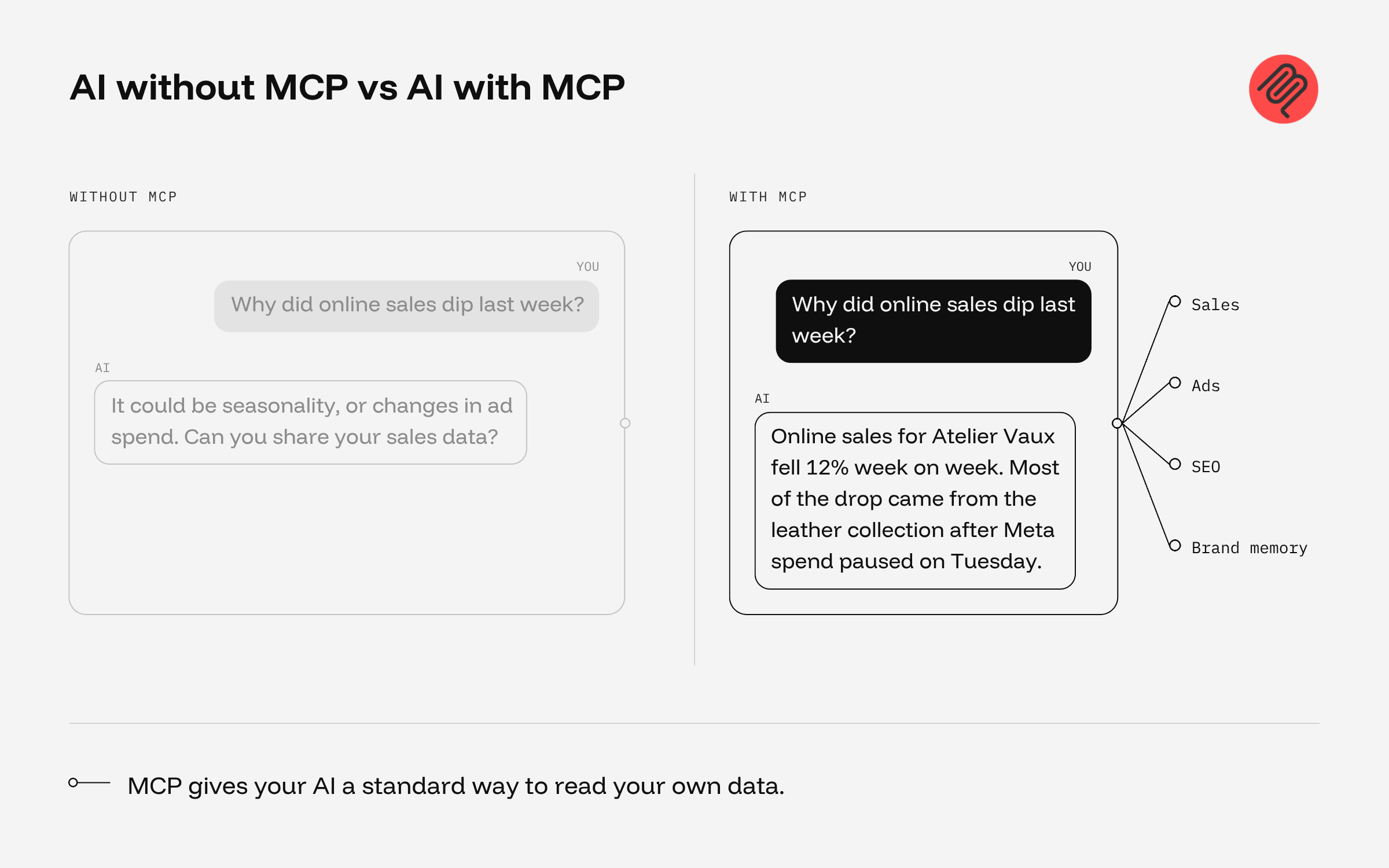
A few points are worth knowing as a founder:
- MCP works inside tools your team may already use, such as Claude and ChatGPT. There is no new app to learn.
- You decide what gets connected. MCP supports standard sign-in and permission controls, so access can be limited to specific accounts and data.
- MCP is an open standard, so it is not tied to one AI company. If your team switches tools later, the connections can come with you.
Why this matters more for luxury brands
Every business benefits from AI that can see its own data. For luxury brands, the stakes are higher, for three reasons.
First, voice is part of the product. A luxury brand spends years building how it speaks: the words it uses, the words it avoids, the rhythm of a product description. Generic AI copy wears that down quickly. An AI that can read your brand guidelines and past campaigns before it writes gives you a far better starting point.
The Business of Fashion made the same case when it looked at why some luxury AI campaigns work and others fail:
Second, small numbers carry big weight. A luxury brand might sell a few hundred units of a piece in a season. A shift in return rates, a drop in branded search or one weak ad set can matter a great deal. Founders need to see those changes early and understand why they happened.
Third, teams are lean. In our experience, many independent luxury labels run small marketing teams that juggle e-commerce, paid media, SEO, PR and content. Hours spent pulling reports are hours taken away from the creative work that sets the brand apart.
What this looks like in practice
Take Atelier Vaux, a fictional luxury brand, as an example. Imagine their marketing lead opens Claude on a Monday morning and asks: “How did the autumn campaign perform last week, and which products drove the most revenue from paid search?”
With the right connections in place, the AI pulls the sales and ad figures, compares them with the week before, and gives a clear answer in seconds. The marketing lead then follows up: “Draft two Instagram captions for the best performer, in our voice, and mention the atelier where it is made.” The AI already knows how Atelier Vaux writes, which products are in the range and what is launching next month, so the draft needs only light editing.
That is the shift MCP makes possible. Your numbers and your brand sit in one conversation, inside the AI tool you already use.
What to keep in mind before you start
The value of a standard like MCP depends on what you connect and how well it is set up. As EDITED puts it, “MCP is only as good as the data behind it.” Style Arcade makes a similar point for fashion retail: an AI connected to raw data still has to work out how that data fits together, and it can make mistakes along the way.
A few questions to ask before you begin:
- Which data sources answer most of your team’s weekly questions? For most brands we work with, these are e-commerce sales, paid ads and search data.
- Where does your brand knowledge live today, and is it written down clearly enough for an AI to use?
- Who on the team should have access, and to what?
Clear answers to these questions are what turn an AI that guesses into one that helps.
Something we are working on
At emand, we have spent years working with luxury brands on paid media, SEO and content. We have watched the same problem play out again and again: teams with good data, a strong brand and AI tools that know nothing about either.
So we are building something to change that. It brings your sales, ads and SEO numbers together with how your brand speaks, what it sells and what is coming up, inside the AI tools your team already uses, including Claude, ChatGPT and Gemini. We will share more soon.
For now, we are opening a small number of places in a 6-week paid pilot for luxury brands. The pilot costs $2,500, and the full amount is credited toward setup if you continue.
To see what this could look like for your brand, visit mcp.emand.me. You can try the demo there and send us an inquiry about the pilot.
Sources
- Anthropic, “Introducing the Model Context Protocol,” 25 November 2024
- Model Context Protocol, “What is the Model Context Protocol (MCP)?” official documentation
- Model Context Protocol, specification (latest version)
- Model Context Protocol, “Understanding Authorization in MCP”
- TechCrunch, “OpenAI adopts rival Anthropic’s standard for connecting AI models to data,” 26 March 2025
- OpenAI, “Building MCP servers for plugins and API integrations,” OpenAI API documentation
- TechCrunch, “Google to embrace Anthropic’s standard for connecting AI models to data,” 9 April 2025
- EDITED, “What is MCP? How Model Context Protocol is Transforming Retail AI”
- Style Arcade, “What is a Model Context Protocol? How fashion retailers can use MCP AI to transform merchandising,” 10 August 2026
- Vogue, “The Anti-AI Slop Playbook,” 30 March 2026
- Camille Oudinot, “Teaching AI your brand voice,” LinkedIn post, 8 July 2026
- The Business of Fashion, “Why Some AI Ads Flourish and Others Fail,” 14 April 2026
- The Business of Fashion (@bof), Instagram post on AI in luxury advertising, 14 April 2026