Summary:
We asked ChatGPT a simple question: which fine jewelry brand should I buy for a gift under $2,000 in the US? The answer showed that AI recommends brands it can describe in one sentence, trusts what the press says about them, and checks product pages before backing a pick. Here’s what that means for luxury brands, and the GEO playbook we use to help our clients make the shortlist.
The experiment
AI assistants are now a shortlist engine for luxury purchases, and most jewelry brands have no idea whether they are on that list. So we stopped guessing and went shopping.

We opened ChatGPT, played the part of a regular buyer, and typed one plain prompt:
"Fine jewelry brand you would recommend to buy a gift under 2k dollars in the US?"
No brand names, no hints, no follow-up instructions. Just the kind of question a partner asks two weeks before an anniversary. Then we read every answer, clicked every citation, and asked the AI to explain itself.

What we found says a lot about how luxury brands get chosen in AI search, and what Emand now does differently for our clients because of it.
What came back: five brands, each with a job
ChatGPT answered with a ranked list of five brands, a price range for each, a photo, a "best gift" line and a shop link. Catbird took the top spot, tagged as its favorite for something special, at roughly $150 to $1,500+. Kinn Studio, Mejuri, Tiffany & Co. and Foundrae followed.
The most revealing part was the summary table at the end. ChatGPT did not rank the brands on quality. It assigned each one a buyer motivation:
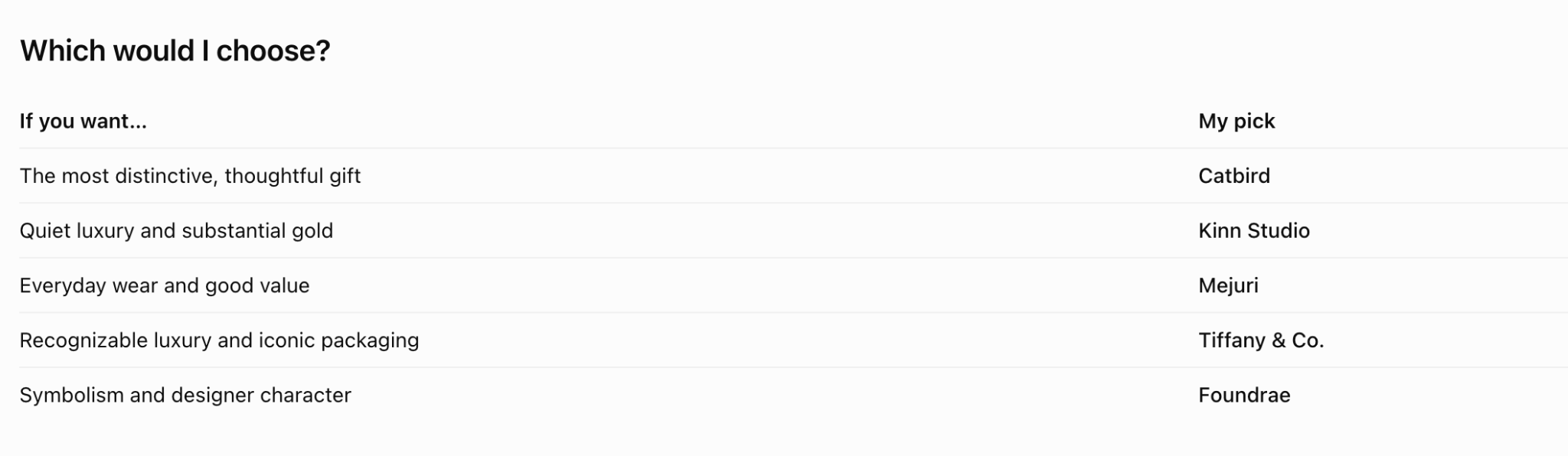
This is the first lesson. The AI recommends brands it can describe in one sentence. Every brand on that list owns a clear position: romantic and handcrafted, quiet luxury, everyday value, iconic heritage, symbolism. A brand with a vague identity has no row to win.
It even closed with buying advice: one solid 14k or 18k gold piece with a small diamond beats several plated pieces, and leave room for sales tax. The assistant is acting like a knowledgeable shop assistant, and shop assistants recommend what they understand.
Where its confidence comes from: press and third-party mentions
Every recommendation carried small citation chips. When we opened them, almost none pointed to the brands' own websites. They pointed to what other people had written about the brands:
- Catbird was backed by Apart Style ("Catbird vs. Mejuri: Which brand should you buy? [2026]", March 2026) and Ét Maison ("The 5 Best Ethical Jewelry Brands of 2026 Reviewed", July 2026).
- Foundrae was backed by Vogue.
- Kinn Studio was backed by Editorialist.
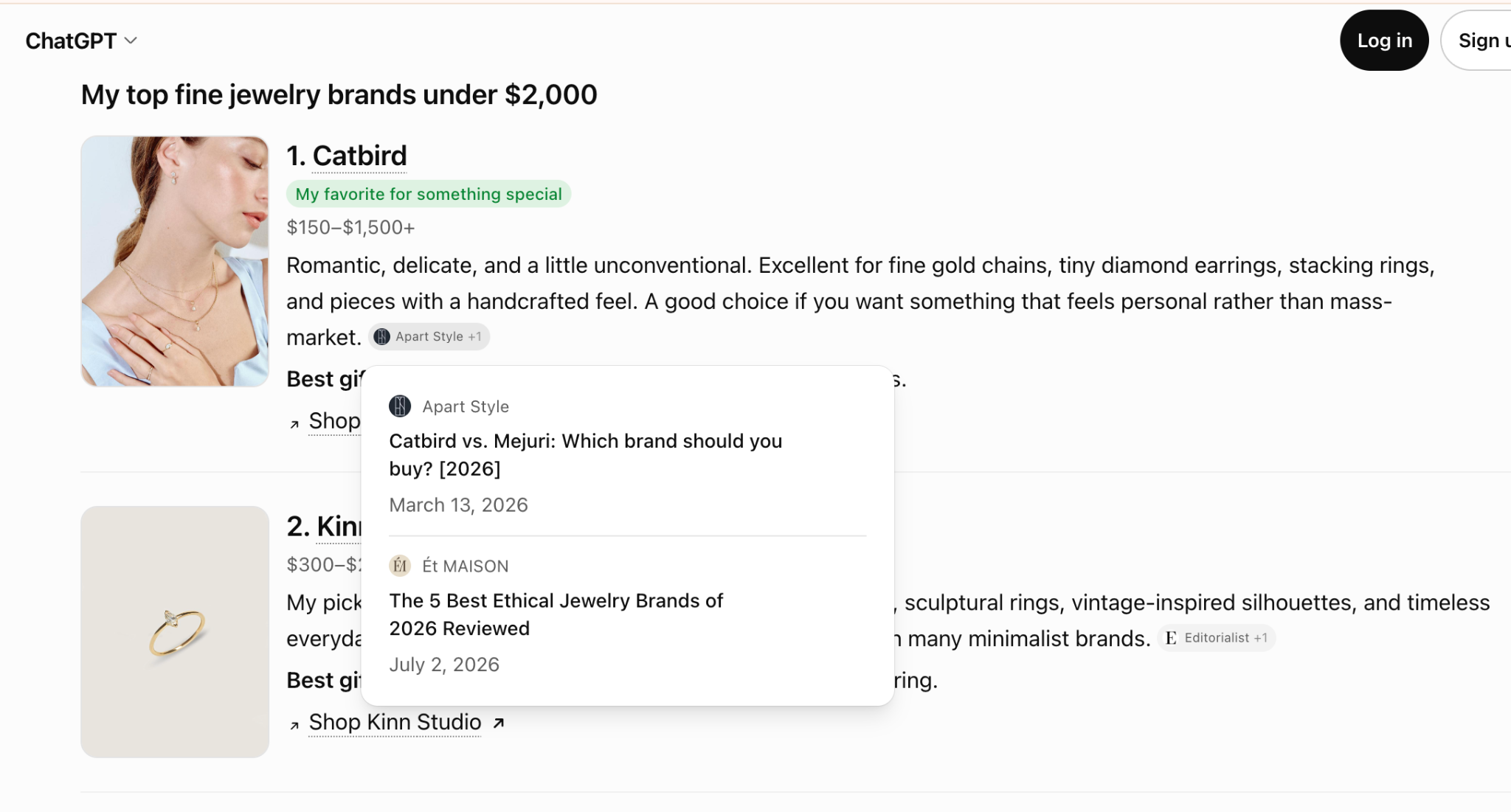

Two things stand out. First, comparison and "best of" articles carry real weight; a single "X vs. Y" piece put Catbird in the conversation. Second, the sources were recent, dated 2026. The AI favors fresh, specific coverage over a press mention from five years ago.
This is where PR stops being a vanity metric. A feature in a trusted publication is no longer just a logo for the "As seen in" bar. It is evidence an AI model reads, quotes and uses to justify putting your brand in front of a buyer.
The "so random" moment
Then we pushed. We asked ChatGPT for a specific product and why it chose it. It landed on Kinn Studio's Swan Dream Diamond Pendant Necklace: $1,200, solid 14k gold, 0.09 carats of natural diamonds, with "Trust Your Path" engraved on the reverse.


When we asked it to justify the pick, the answer was refreshingly honest. It admitted it chose the necklace on its own design judgment. It was not based on customer reviews, expert rankings or evidence that this was one of Kinn's best-selling gifts. It also corrected itself: its first answer had linked to a different-looking product page.
Only after it opened the official product page did the recommendation firm up. The page itself explained the swan as a symbol of grace and self-trust, and positioned the pendant as a small talisman for everyday wear. That copy gave the AI the "personal" and "meaningful" angle it needed to defend its choice.
This is the second lesson, and the one that should worry most brands. AI recommendations can be fragile. A product can land on the shortlist almost by chance, and stay there only if the product page can back up the claim. If the story behind a piece lives only in an Instagram caption or a press release, the AI cannot find it when it needs it.
How an AI arrives at a recommendation
So we asked ChatGPT the obvious question: how does a jewelry brand get recommended by you? Its answer boiled down to three tests. The product must be right for the buyer, the brand must be credible, and the item must be worth choosing over the alternatives.
It described its decision process in four steps:
- Match the buyer's intent. A gift, for a partner, under $2,000, from a designer brand, in a quiet-luxury style.
- Discover relevant products. Necklaces with the right materials, price, aesthetic, availability and gift suitability.
- Verify the claims. Check the official product page for composition, dimensions, price, shipping, returns and design details.
- Differentiate from competitors. Decide why this necklace beats a simple gold pendant from Mejuri or an iconic Tiffany design.
ChatGPT was careful to call this a framework rather than a fixed algorithm, and we agree. But it maps neatly onto work a brand can control. Step 1 is positioning. Step 2 is discoverability. Step 3 is your website. Step 4 is your story and your press.
OpenAI's own shopping documentation points the same way. It says product results are chosen independently by ChatGPT and are not ads, and that merchant lists are built from product metadata supplied by third-party providers or by merchants directly. In other words, you cannot buy your way into this list. You have to earn it with clear information.

Our playbook: how we optimize luxury brands for AI visibility
At Emand and with our partner Mega Mega, we treat GEO (generative engine optimization) as the point where SEO, PR and merchandising meet. No single channel gets a brand recommended. Here is what we do for clients.
1. Own one sentence
Before any technical work, we define the one line an AI should be able to say about the brand. "Quiet luxury and substantial gold." "Symbolism and designer character." That line then runs consistently through the homepage, the About page, collection pages, press materials and social bios. If your own channels describe you five different ways, the AI will pick none of them.
2. Write product pages for the buying situation, not just the product
Specs alone don't win the gift query. Every hero product page should state, in visible text:
- Materials and specs: metal and karat, stone type, carat weight, dimensions.
- The meaning: the motif, the engraving, the story behind the design.
- The use case: who it suits, what occasion, what style of wearer.
- The practical details: price, shipping, returns, gift packaging, engraving options.
The Kinn Swan necklace is the model. It moved from a "random" pick to a defensible one because the page explained why it makes a meaningful gift. Put those claims on the page itself, never only in an image, a reel or a PDF lookbook.
3. Build pages around real buying decisions
Shoppers don't search for "necklace." They ask for "a meaningful gift for my partner under $2,000." We build genuinely useful editorial and shopping pages around those decisions:
- Fine jewelry gifts under $2,000, with real prices and direct product links.
- Luxury necklaces for everyday wear, explaining what makes a piece understated.
- Meaningful jewelry gifts for a partner, comparing motifs, engravings and personalization.
Each page should help someone actually decide, with clear criteria and current products, not repeat "best luxury necklace" twenty times. These pages also give editors and bloggers something worth citing.
4. Turn PR into citable evidence
The AI leaned on Vogue, Editorialist, Apart Style and Ét Maison. So we pitch for the formats AI models quote most:
- Gift guides and "best of" roundups, refreshed every season.
- Brand comparison articles ("X vs. Y").
- Category features on ethical sourcing, lab-grown vs. natural diamonds, or solid gold vs. plated.
Every placement should repeat the brand's one sentence and name specific products, with links to the right product pages. Fresh coverage matters: the citations we saw were all from 2026.

5. Keep every source in agreement
The AI cross-checks. If the product page says $1,200, the Google Merchant Center feed says $980 and a retailer still lists last year's price, trust drops. We audit price, stock, materials and product names across the website, structured data, shopping feeds, wholesale partners and press.
6. Measure AI visibility like a channel
We run a fixed set of buyer prompts every month across ChatGPT, Google AI Overviews, Gemini and Perplexity. We track whether the client appears, in which position, with which description, and which sources are cited. Then we connect that to analytics and CRM data, so AI referral traffic sits alongside paid, organic and email in one view.
The technical checklist
Beautiful photography and storytelling mean nothing if AI systems can't read the site. These are the foundations we check first in every AI visibility audit:
- ☐ Let the AI crawlers in. Allow OAI-SearchBot in robots.txt and make sure your CDN, firewall or bot protection isn't blocking it. OpenAI states that sites opted out of OAI-SearchBot won't appear in ChatGPT search answers. Note it is separate from GPTBot, which is for training, so you can allow search while blocking training.
- ☐ Add Product structured data. Use Schema.org Product and Offer markup for name, brand, price, currency, availability, images and URL, plus variants such as metal color or chain length.
- ☐ Add Organization and Brand markup. Link your official social profiles and key press so systems can connect the brand across the web.
- ☐ Submit clean product feeds. Keep Google Merchant Center accurate. If you are on Shopify, your catalog already feeds into ChatGPT shopping via Shopify Catalog; other merchants can apply to OpenAI for direct product feed access.
- ☐ Make products visually identifiable. Crawlable, high-quality images on a plain background, on a model, in close-up and at a realistic scale, with descriptive alt text and stable image URLs.
- ☐ Put key facts in HTML text. Materials, carat weight, engraving and gifting details should be readable text, not baked into images or hidden behind scripts.
- ☐ Answer the questions buyers ask. A short FAQ on product and category pages covering sizing, care, solid vs. plated gold, natural vs. lab-grown diamonds, delivery times and returns.
The takeaway: be easy to find, easy to judge, easy to trust
There is no formula that guarantees an AI will pick your brand. Even ChatGPT told us its own recommendation was a single, context-dependent judgment. But the brands that showed up shared three qualities:
- Easy to discover. The site is open to AI crawlers and the product data is clean.
- Easy to evaluate. Materials, design, price and who the piece suits are spelled out.
- Easy to trust. Consistent information everywhere, backed by independent press.
And a fourth, quieter one: a product needs a reason to be selected, not just a reason to be indexed. The Swan necklace had a story. The brands in the table each had a role. That is the work: make the advantage clear, then give shoppers and AI enough facts to agree with you.
This is exactly why Emand and Mega Mega work as one system. PR builds meaning, content builds desire, UX and SEO build trust, performance captures intent, and data shows us what is working.
Want to know where your brand stands? We run AI visibility audits that test your brand against real buyer prompts across ChatGPT and Google AI Overviews, then map out exactly what to fix. Write to us at hello@emand.me.
Sources