Why we tested it
Every few years a new channel appears and agencies feel the pull to be first. Right now, that channel is ChatGPT Ads.
It has moved fast. OpenAI began testing ads with US users on 9 February 2026, with pilot commitments reported in the 250,000 range. On 5 May 2026 it removed the minimums and opened a self-serve Ads Manager to US advertisers. In August 2026 it expanded to the UK and dozens of European markets.

Big brands are already in, including Target, Ford, HelloFresh, Audible and the luxury watchmaker Audemars Piguet.
For fine jewelry, the logic is obvious. People already use ChatGPT for the research that comes before a jewelry purchase:
- "What's the difference between lab-grown and natural diamonds?"
- "Anniversary gift ideas for my wife"
- "How much should I spend on an engagement ring?"
These are high-consideration, high-intent moments. We wanted to know whether a luxury brand could show up in them, and whether it would pay off.
Our test at a glance
- Brand: Independent fine jewelry brand, direct-to-consumer, high average order value
- Market: USA
- Duration: Over the summer of 2026
- Budget: A ring-fenced test budget
- Campaign setup: Separate campaigns for rings, gifting and a hero product
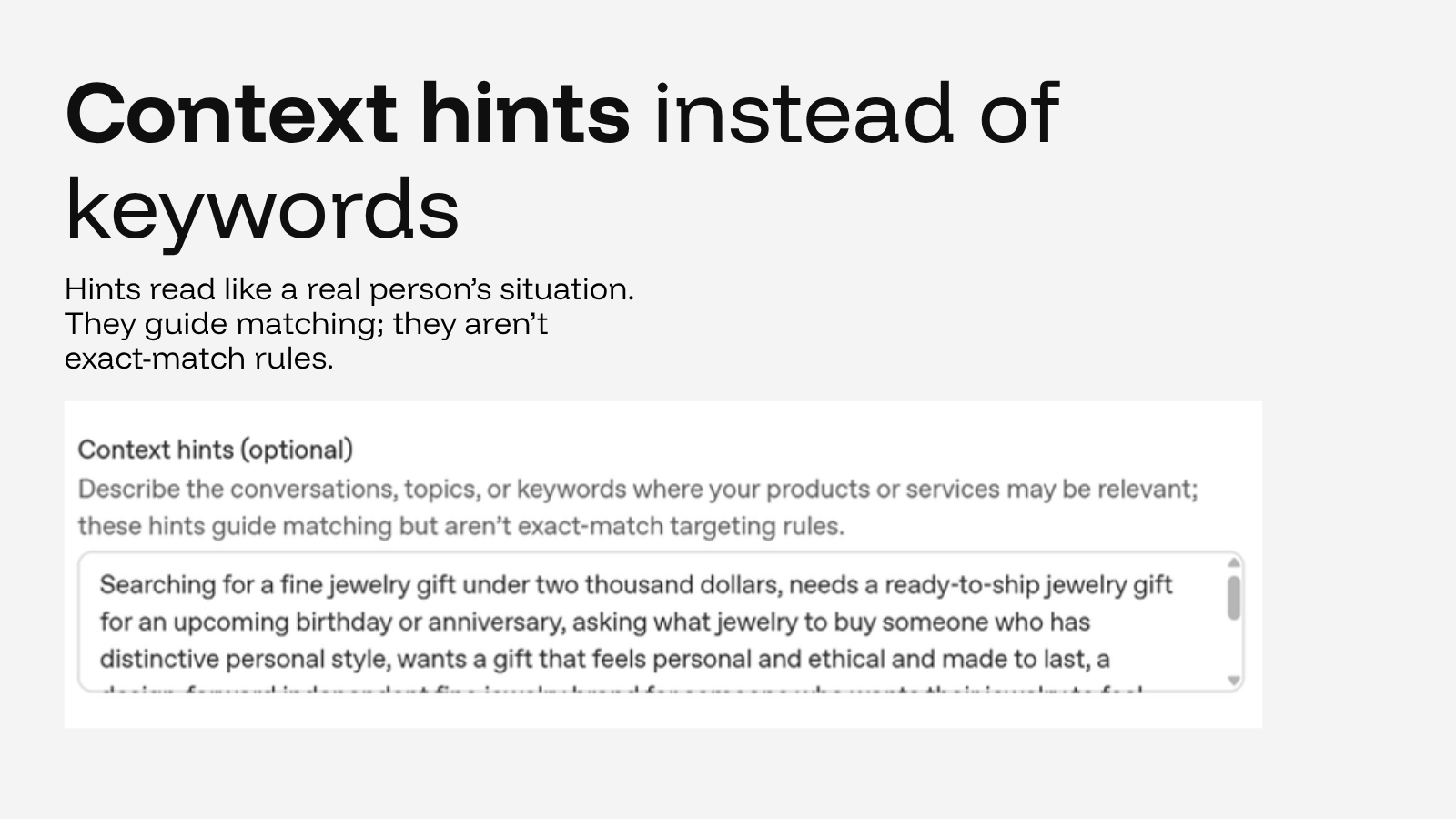
- Context hints example: "looking for a ring that doesn't follow traditional engagement or wedding conventions, from an independent, design-forward fine jewelry brand"
- Tracking: OpenAI Pixel
How ChatGPT Ads work
If you're used to Google or Meta, the mechanics will feel familiar, but the targeting won't.
- Placement: A sponsored card below ChatGPT's answer, clearly labelled and visually separated from the response
- Who sees ads: Logged-in adult users on the Free and Go plans only. Plus, Pro, Business, Enterprise and Edu users see none
- Targeting: Context hints: plain-language descriptions of the conversations where your ad fits. Not keywords, not demographics
- Auction: Relevance-weighted, second-price auction
- Bidding: CPM, CPC and conversion-optimised CPC (oCPC)
- Pricing: CPM roughly USD 25–60; recommended CPC bids around USD 3–5
- Minimum budget: USD 25 per day per campaign (USD accounts)
- Geo targeting: Country level
- Measurement: OpenAI Pixel, Conversions API, UTM parameters, and a growing list of attribution partners
Pricing is based on early market reports and moves quickly. Check current figures in Ads Manager before budgeting.
Lesson 1: Measurement is the biggest challenge
On Google and Meta we can trace the path from impression to purchase. ChatGPT Ads doesn't give us that yet.
- You never see the conversation. Advertisers get no chat histories or conversation details, so you can't know which question your ad appeared under.
- Reporting is thin. There are no deep audience insights, placement reports, demographic breakdowns, or data on which conversation types triggered an ad.
- Data lags and gaps. Other advertisers report click-tracking discrepancies and 24–36 hour delays in conversion reporting.
- Legal friction. Some brands' legal teams have been slow to approve OpenAI's conversion tracking because of data-handling questions.
Fine jewelry makes this harder. The path to purchase takes weeks, not minutes. Customers visit a showroom, compare stones, and often buy offline. A channel with thin attribution will take longer to show its full value in a category where last-click was never the full story.
What we saw: Traffic was easy to track, but it wasn't cheap. That makes sense for a channel where people are having detailed, personal conversations about what they want to buy, sometimes about the brand itself or the exact situations we described in our context hints. Those visitors arrive with far more context than a typical ad click, and that's what you're paying for.
Lesson 2: You can't target as precisely as you're used to
Paid media teams are used to keywords, audiences, demographics and remarketing windows. ChatGPT Ads works on context hints instead. OpenAI describes them as broad thematic signals that guide matching, not exact-match rules, and they don't guarantee delivery in any specific conversation.
The levers you do have:
- Location, at country level.
- Platform: iOS, Android or desktop.
- Custom audiences, which usually need at least 25,000 matched users to be used. Many luxury CRM lists are small and high-value, so they won't reach that threshold.
In Europe it's narrower still. Personalised ads aren't initially available in the EEA or Switzerland, so ad selection relies on the current conversation, general location and device. In practice, ChatGPT Ads is a contextual channel in Europe, not an audience channel.
Brand safety is mostly in OpenAI's hands. There's no documented negative or exclusion targeting yet; OpenAI is reportedly testing exclusion options with a small group of advertisers. Until then, the only workaround is writing what you don't want into the hint itself.
For a luxury brand, where context and placement matter as much as reach, that means handing over a lot of control.
What we saw: The hints that were very specific such as "wants reassurance a gift is from a reputable, up-and-coming fine jewelry brand, featured in Vogue and worn by celebrities" or "comparing lab grown diamond studs across fine jewelry brands" seemed to bring the highest engagement on the website.
Lesson 3: The product feed isn't stable yet
Shopping in ChatGPT relies on merchants submitting product feeds in OpenAI's format: ID, title, description, price, availability and images. Product-feed ad campaigns use a separate feed system again.
The strategy has also shifted. OpenAI moved away from Instant Checkout and now focuses on product discovery, sending shoppers to the retailer's own site.
For fine jewelry this matters more than for most categories:
- Products carry many attributes: metal, carat, cut, clarity, ring size.
- Prices are high, so a wrong price is a real problem, not a rounding error.
- Stock is often one-of-a-kind, so availability goes stale quickly.
An unstable feed means wrong prices, outdated availability, or products that simply don't show.
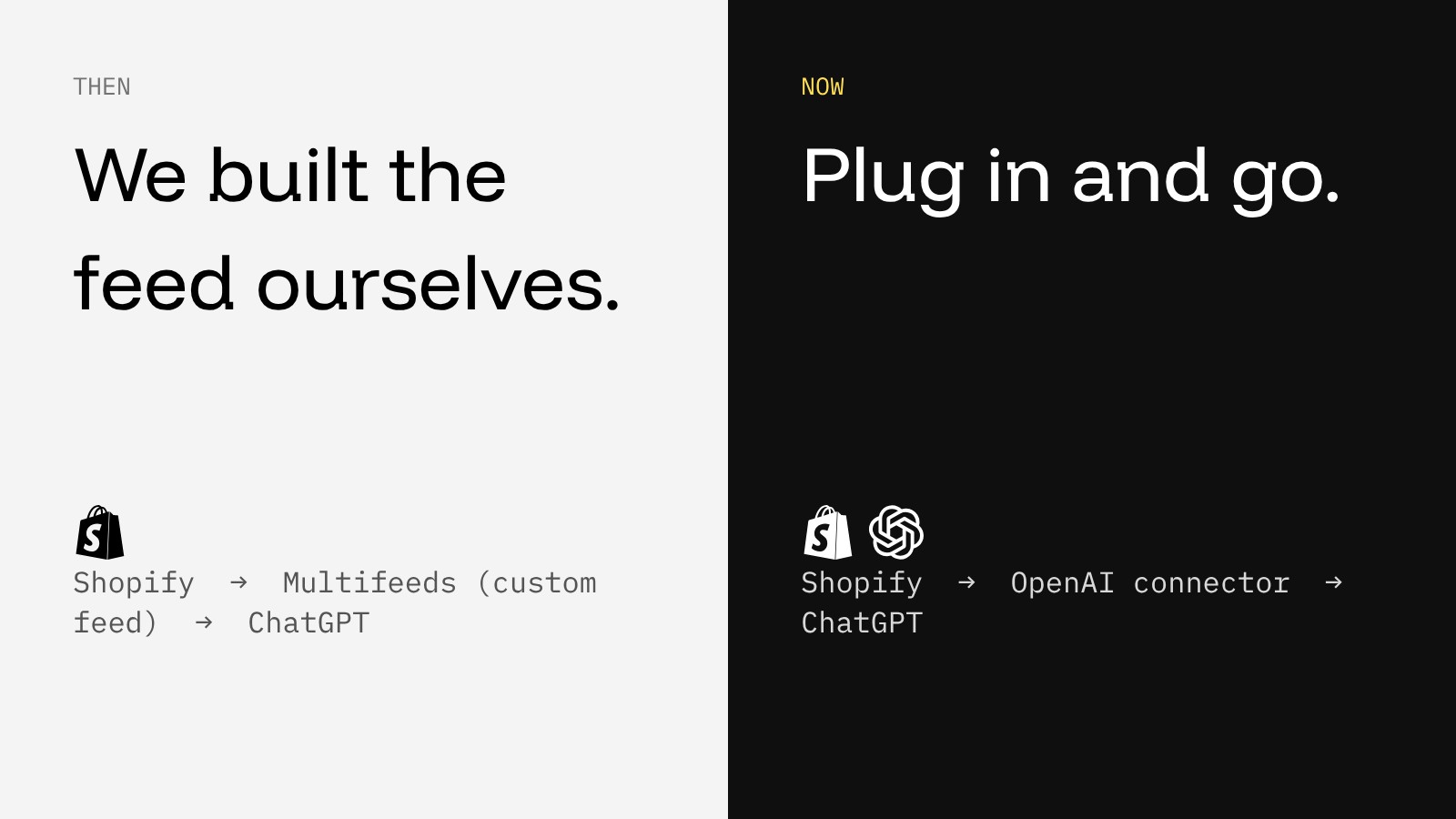
What we saw: When we launched there was no Shopify connector, so we built a custom product feed through the Multifeeds Shopify app and handled all of the configuration ourselves. OpenAI has since added a Shopify connector, so brands starting now should have a much easier time getting their products in.
Lesson 4: It brings high-intent traffic, and measurement is still catching up
ChatGPT Ads brought us engaged, high-intent traffic. Connecting that traffic to revenue is harder, because the tools for tracing a long jewelry purchase journey are still being built.
That matches the mixed picture across the market:
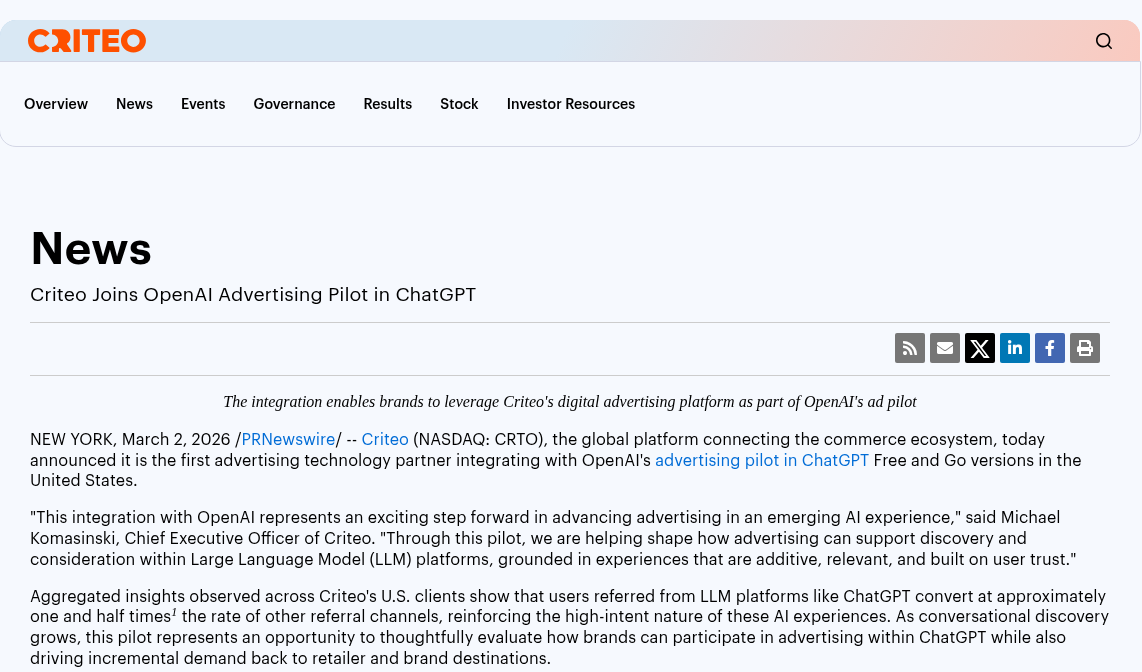
- Positive signals are real. Criteo found that shoppers referred from AI platforms like ChatGPT convert at about 1.5x the rate of other referral channels, based on 500 US retailers in February 2026. In September, Criteo's CEO said lower-funnel ChatGPT Ads traffic converts 1.5–2x better than traditional search.
- Some brands report efficiency. WeightWatchers reportedly saw a 15.3% lower attributed CPA than its blended paid search benchmark.
- Results vary. Early testers report very different outcomes depending on category, setup and how long they ran.
Our read: today it works best as a mid-funnel channel, reaching people while they're still deciding. That's worth judging on its own terms rather than on a last-click ROAS target.
Should your luxury brand test ChatGPT Ads now?
Yes, if you treat it as a learning budget, not a sales channel. Being early lets you learn how your customers phrase their questions, and that insight is valuable well beyond ads.
Before you spend, we'd recommend:
- Set up tracking first. Install the OpenAI Pixel or Conversions API, tag every landing page with UTMs (utm_source=chatgpt), and get legal sign-off before launch, not after.
- Ring-fence the budget. Fund it as a test, separate from your performance budget, so it isn't judged on last-click ROAS.
- Judge it on mid-funnel signals. Track product views, add-to-carts, newsletter sign-ups, appointment bookings and branded search lift alongside purchases.
- Write tight context hints. One theme per ad group (engagement rings, gifting, diamond education), each describing a real customer question.
- Clean your product feed. Check prices, availability and variants weekly, especially on one-of-a-kind pieces.
- Run it for long enough. Jewelry purchase cycles run for weeks. Give the test at least 8–12 weeks before calling it.
- Don't neglect organic visibility. Ads sit below the answer. Being cited in the answer itself, through strong SEO and AI Visibility optimisation, often matters more, especially in Europe where targeting is limited.
The bottom line
ChatGPT Ads is early and moving fast. The intent is already there, and the measurement, targeting and feed tooling are improving with every update. For a fine jewelry brand, that makes it worth testing now with care, so you learn how your customers ask before the channel gets crowded.
We'll keep testing and update this post as the platform matures.
Thinking about ChatGPT Ads for your brand? Emand helps luxury brands test new channels without losing sight of what drives revenue. Schedule a call or email us at hello@emand.me.